Automated Field Input
This capability maps to POST /api/endpoints/chat/field_input. The goal is to turn natural-language, speech, or image-derived information into structured updates for a protocol's fields.
A simple example
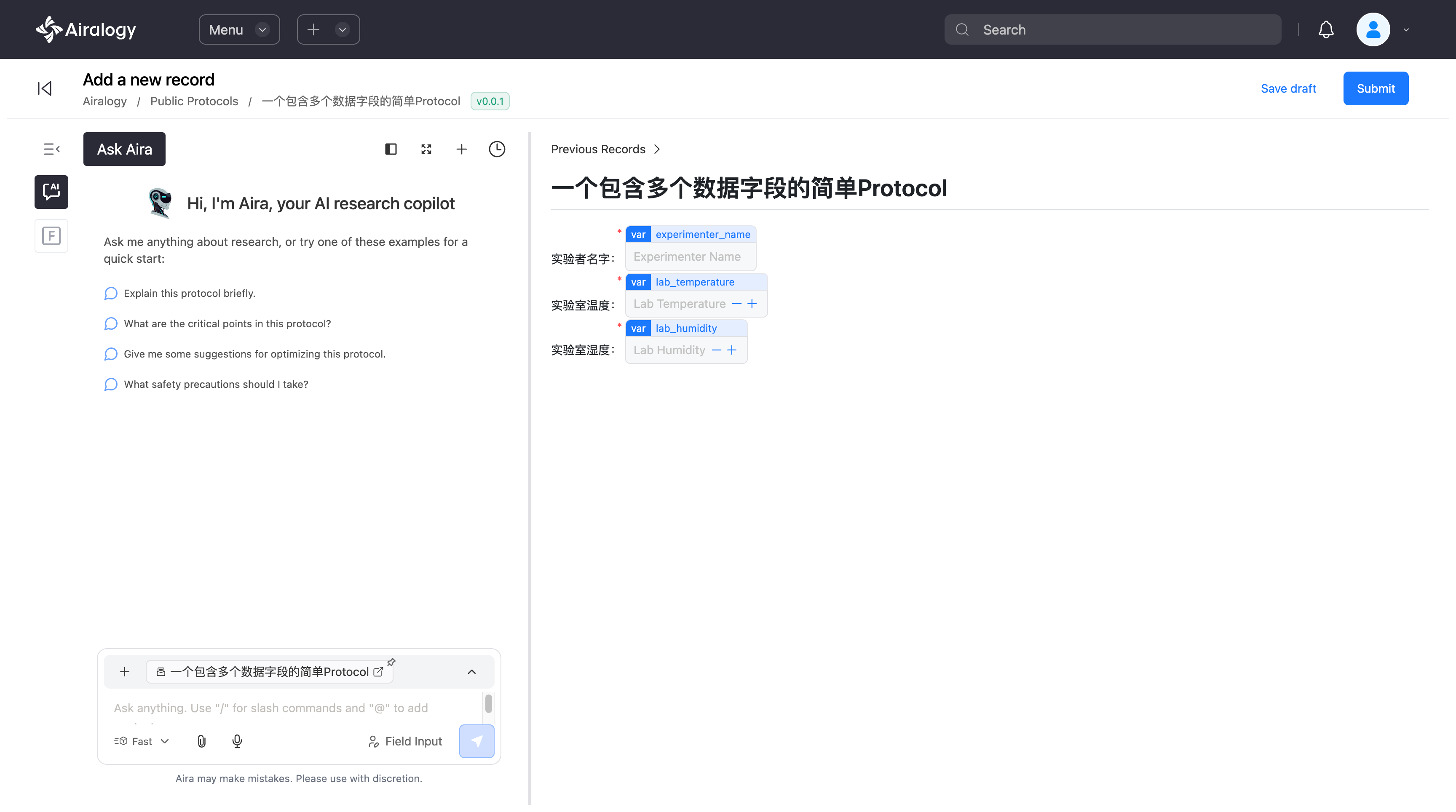
Suppose a protocol defines these fields:
txt
Experimenter name: {{var|experimenter_name}}
Lab temperature: {{var|lab_temperature}}
Lab humidity: {{var|lab_humidity}}
With a corresponding model:
py
from pydantic import BaseModel


class VarModel(BaseModel):
    experimenter_name: str
    lab_temperature: float
    lab_humidity: float
That schema gives the backend enough structure to translate user input into explicit field operations.
Flow
mermaid
sequenceDiagram
    participant User
    participant Frontend as AI interaction UI
    participant Backend as AI backend
    participant Record as Record service

    User->>Frontend: Provide text, speech, or images
    Frontend->>Backend: Send field-input request
    Backend->>Backend: Parse intent against the field schema
    Backend->>Record: Send structured operations
    Record->>Backend: Return acknowledge results
    Backend->>Frontend: Return a user-facing response
    Frontend->>User: Show updated values
Operation payload
The central backend artifact is a list of operations:
json
{
  "operations": [
    {
      "operation": "update",
      "field_id": "experimenter_name",
      "field_value": "Zhang San"
    },
    {
      "operation": "update",
      "field_id": "lab_temperature",
      "field_value": 25.0
    }
  ]
}
Here:
field_idmatches a field in the protocol schemafield_valueis what the model extractedoperationdescribes the action, usuallyupdate
Acknowledge payload
After execution, the record side can return per-operation results:
json
{
  "operation_results": [
    {
      "success": true,
      "field_id": "experimenter_name",
      "field_value_updated": "Zhang San",
      "message": "The value of experimenter_name has been set."
    }
  ]
}
If validation fails, success should be false and message should explain why.
Relationship to chat
From the conversation model's perspective, field input is still a standard tool call:
- the user describes what should be filled
- the assistant issues a
field_inputtool call - the tool returns structured results
- the assistant turns that into a user-facing confirmation
That lets the UI reuse the same chat rendering model while the backend preserves structured execution results.